A Healing Journey: Catalina
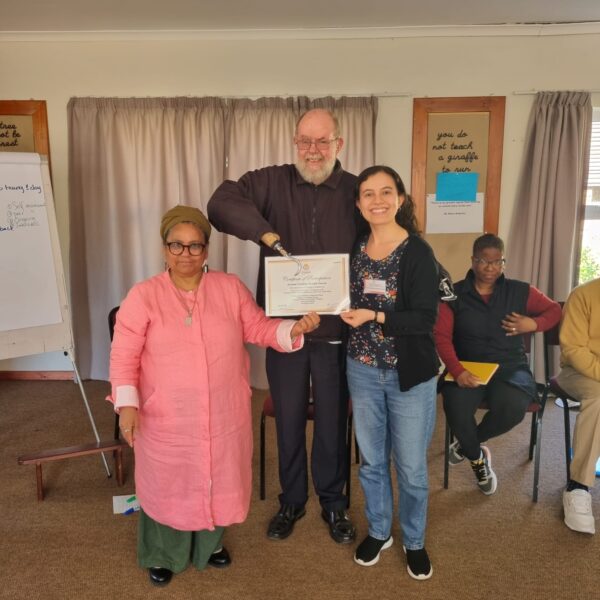
As part of my internship and role as a member of the Commission of the Churches in Health and Healing from the World Council of Churches, I had the opportunity to participate in the Introduction to Healing of Memories International Course in Stellenbosch, South Africa, from September 5th to 13th. The course brought together participants from various countries, including Zimbabwe, Lesotho, Spain, Ghana, Namibia, Colombia, Sweden, the United States, and South Africa.
For many of us, it was our first time engaging with a training program from the Institute for Healing of Memories—a long-standing organization founded by Father Michael Lapsley, a freedom fighter during the apartheid regime. The Institute is widely recognized for its profound belief that everyone has a story to tell, and every story needs to be heard.
Before attending the training, my expectations were along the lines of: “Maybe I will listen to the stories of people who have endured very difficult circumstances in life, and I will learn to accompany them in their healing journey” or “I will learn the methodology followed by facilitators working with small groups.” Essentially, I expected to remain emotionally detached during the course.
To my surprise, I was wrong.
While we did explore the topics I anticipated, the approach was entirely different from what I had imagined. Before learning about the methods or hearing anyone else’s story, I was invited to face my own story—to confront my roots and my wounds.
After completing the first part of the training, I came to understand the deep importance of taking time to reflect on one’s personal journey. Without acknowledging and processing my own life experiences—especially the painful ones—I realized I couldn’t develop the sensitivity required to truly listen to others, or to offer meaningful encouragement and support.
I also discovered that the types of questions I was accustomed to asking in academic settings had little relevance in this context. Instead of “mind-type” questions, I had to learn how to ask “heart-type” questions—questions about feelings, memories, and meaning. I learned how to encourage people to confront their “unfinished business,” and to take action—whatever that may look like for them—as a step toward healing.
This training was an extraordinary experience. It not only deepened my understanding of trauma and past wounds but also emphasized the power of journeying together toward healing. Because healing is not a one-time event—it is a lifelong journey.
Catalina Bonilla
Catalina Bonilla is a Research Master’s student in Theology and Religious Studies, with a professional background in nursing. Originally from Bogotá, Colombia, she currently serves as co-chair of the Mental Health working group in the Commission of the Churches on Health and Healing at the World Council of Churches. In this role, she leads initiatives focused on trauma healing.