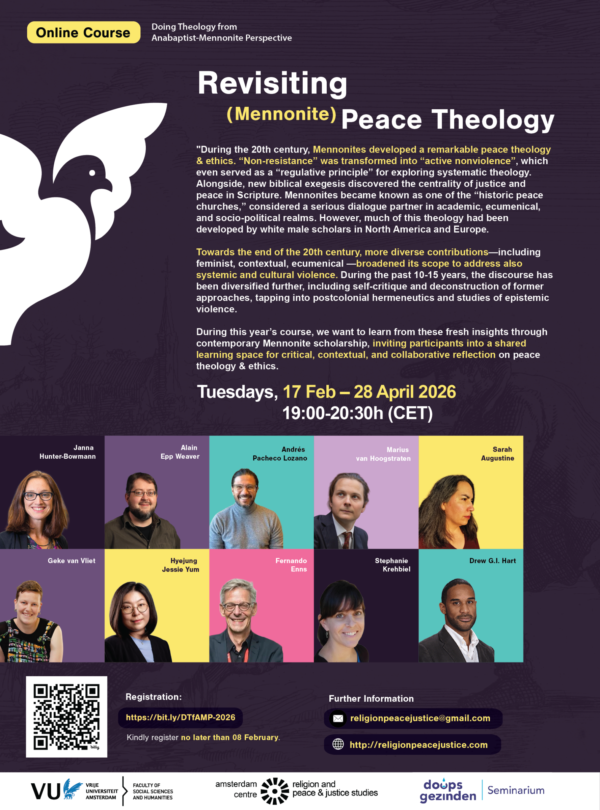
2026: REVISITING (MENNONITE) PEACE THEOLOGY & ETHICS
During the 20th Century, Mennonites have developed a remarkable peace theology and peace ethics. “Non-resistance”, once an identity marker of the Anabaptist-Mennonite tradition, had been transformed into “active nonviolence” as an engaged and prophetic witness in society. In correlation, nonviolence became a “regulative principle” for exploring systematic theology (in basically all traditional topoi, such as Christology, Ecclesiology, Eschatology, etc.). And new biblical exegetical contributions proved the centrality of justice and peace in Scripture.
Mennonites became known as one of the “historic peace churches”, considered a serious dialogue partner – in the academy, in ecumenical relations, as well as in the socio-political realm. This “school” of doing peace theology & ethics, so closely interrelated, has shaped self-understandings and identities in Mennonite churches around the globe.
Fact is, that most of that theology & ethics had been developed by white male scholars in North America, Canada, and Western Europe. Towards the end of the 20th Century, more diverse contributions came to the fore, including feminist, “contextual” (explicitly reflecting the given contexts) or ecumenical approaches. In its ethical dimensions, the scope was broadened to address the phenomena of systemic and cultural violence (in gender relations, economic systems, in relations of different contextual and ethnic backgrounds, in different political constellations, etc.) – again, finding resonance in unique theological reflections.
During the past 10-15 years, we have witnessed further explorations in this regard, including some strong self-critique and deconstruction of former approaches. A further diversified Mennonite global community (and gradually also academy), tapping into postcolonial hermeneutics and studies of epistemic violence, analysing phenomena such as glocalization, climate crisis, migration and more continue to challenge those former approaches , growing into ever more fields of research: Still grounded in the faith that violence is simply not an option for those who try to follow Christ – liberated to live in just relations (sola gratia), yet, not being blind about the self-infliction in violent structures and unjust cultures, which call for self-critical re-lectures and re-visits, inspired to new theological discoveries.
#1 Introduction to the Course and Epistemic Violence
Speaker: Fernando Enns
#2 Reckoning in Mennonite Peace Theology
Speaker: Janna Hunter-Bowman
#3 Unlearning Obedience
Speaker: Marius van Hoogstraten
#4 Returning to the Radical Roots of Anabaptism
Speaker: Sarah Augustine
#5 A Political Theology of Resistance and Fragile Hope
Speaker: Alain Epp-Weaver
#6 Neighbor Love for Climate Justice
Speaker: Geke van Vliet
#7 Gender Justice/Gender Peace
Speaker: Stephanie Krehbiel
#8 Mennonite Innocence
Speaker: Andrés Pacheco Lozano
#9 Anablacktivism
Speaker: Drew G. I. Hart
#11 Chosen Trauma
Speaker: Fernando Enns