Public Lecture: Theology After Gaza
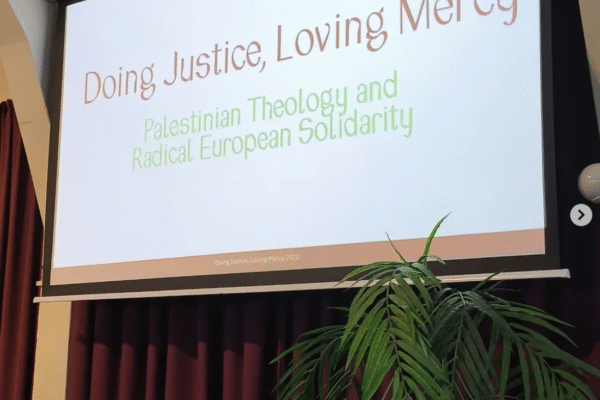
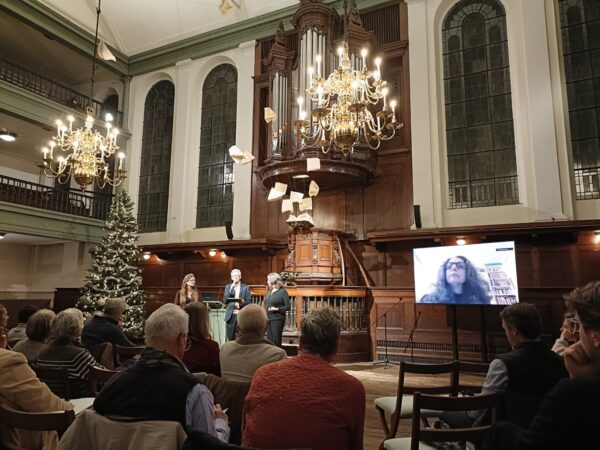
To look at Gaza as if it were the magnifying glass for what is happening in the world: it is keeping this in mind that, on the evening of December 10th 2025, we met with an engaged audience for a presentation of the book “Theology after Gaza” and an open conversation together with one of its editors, Graham McGeoch. The programme included contributions by Viola Raheb, who joined us online, and by Janneke Stegeman. But let’s start describing the evening from the beginning.
There was something powerful in the way the event was opened by artist and storyteller Rasha Hilwi. In a storytelling performance that embodied resistance, Rasha managed to take our breath away and transport us to the Palestine of her childhood through stories of her family, her grandmother in particular. And she sang, she sang with a force that made us all quiet, full of respect and admiration, as she shared a piece of personal and collective history with us.
As we moved to discussing the content of the book, as a non-theologian, I was more than intrigued to learn that the title of the book was inspired by “theology after Auschwitz”, a theological current that spread after WWII. In the same way that Auschwitz represented the failure of theology then, a rupture, Gaza plainly presents us with a new rupture in our time, one that we can not possibly afford to look past, and one that most definitely demands that we change our current ways of doing theology. And in this optic, it was especially interesting to hear that the voices collected in the book are primarily from people in the global majority. The question is clear: will the West listen? With liberation theology representing a clear source of inspiration for the scholars involved in the book, we were presented with the plain realisation that we need to address the complicity of the church and its damage inflicted on the Palestinians. Unfortunately, through questions by the audience, we were also presented with the fact that there is still very much to be done in this regard here in the Netherlands.
Lastly, an element that was present in all parts of the evening was embodiment. This really added to the quality of the event: seeing how all speakers shared not only from a theoretical stance, but also from the point of view of their lived experience was especially valuable. The storytelling moment by Rasha Hilwi really did set the tone for this, opening up the floor for an evening of sharing, questioning, and listening to each other’s experiences.
Written by: Liliana Gaddi