Peace as a Verb: From Fantasy to Imagination
On the 12th of September 2026, State Secretary for Defense Boswijk informed parliament that the armed forces are working on a selectieve opkomstplicht, a selective conscription, so that certain conscripts can be called up “when international security deteriorates or when defense takes on additional tasks, for example from NATO” (NOS). Two weeks later, on the 27th of September, people marched through the streets of Amsterdam to end the ‘warfever’ (oorlogskoorts) and to plead for ‘true’ peace.
The march, then, is not a cry out of nowhere but in line with a militarization quietly settling into the everyday. A conscription here, a NATO task there, I think it is time to speak about ‘warism’, where war is presented as inevitable and morally justifiable (Cady, 2010). So, it was very welcome that the Humanistisch Verbond (HCSS), a Dutch association built on humanist principles, dedicated its latest magazine to War, Peace and Resistance, a theme not merely of its time, but omnipresent. Yet reading it, something struck me while reading the interview with Rob de Wijk, founder of the HCSS and professor of International Relations.
For forty years, he says, he has been warning the West against its ‘‘naivety’’: “…the way the West has been denying reality by wishful thinking”. According to him, we nestle in our comfortable, safe lives, focused on self-development, refusing to see that this is not how the world works. The problem, according to de Wijk, is that we have protected ourselves too much with values rather than interests, which has made us unable to rise against men like Putin and Trump, who operate from a different reality. His motto: if you want peace, prepare for war.
I agree that the West is clinging to a fantasy, but de Wijk seems to misdiagnose the patient. Our problem is not naivety, I would argue, but what Lauren Berlant (2011) calls cruel optimism: an attachment to a good-life fantasy that has ‘less and less relation to how people can live’, yet whose loss we cannot bear, so we keep holding on as it wears us down. We know the blueprint has faded, however we cannot afford to lose the fantasy, according to Berlant.
Berlant’s point is not that capitalism homogenizes the world, but that it disorganizes the overwhelming ordinary, the intimate, everyday scale where this fantasy quietly breaks down. It is precisely that ordinary where men like Trump and Putin thrive: not despite our systems, but through them. So, de Wijk’s cure is the disease in another form. His motto being inspired by si vis pacem, para bellum: an imperial maxim, born of a world that divides humanity into allies and enemies, inside and outside, civilized and barbarian. That binary is the colonial map of the world, carried into the present: ‘the West and its others’. Calling for ‘‘realism’’ while quoting an empire’s slogan is not facing reality; it is inheriting empire’s imagination, the very imagination that Mark Fisher (2022), in Capitalist Realism, describes as making it “…easier to imagine the end of the world than the end of capitalism” (p. 8).
That is why we should not focus more on interests than values, as de Wijk argues, but instead take responsibility and see what it looks like when the fantasy is dismantled. Mitri Raheb (2025) writes: “Fallen is the mask.” As the West we have held up a mask, a mask that already fractured during Covid, when the system’s failure became hard to deny, and that lies shattered today in the face of the genocide on the Palestinian people. Raheb continues stating that; ‘The genocide in Gaza has revealed the true nature of the global empire with its white supremacy, death machines, and settler colonial values’ (p. 84). So, isn’t it time to keep the mask down and start taking responsibility for the mess?
I think it is time to see this reality and admit that we have never truly tried peace. Peace as a verb where we collectively construct fair and non-violent relationships and social conditions, being with people and all other living beings. Trying peace means allowing conflict and discomfort into the process; refusing to look away from the institutional structures underneath and allowing life to possibly not get ‘better’ right away.
So, I agree with de Wijk that we are unable to face reality. But I am less interested in blame than in the question of what comes after the fantasy. How do we start imagining a better future, one where everyone can flourish? How do we become equal with each other, rather than implementing equality? I would like to invite you to open up the imagination and ask: what might a story of peace look like, and who is telling these stories?
Imagining a better future is deeply political, one that empowers our ability to act, as Hajer and Oomen (2026) invite us to do: stepping outside the drama, letting go of our fantasy and allowing for ‘ontological insecurity’. Stepping into the discomfort of no longer knowing who we are without it. Allowing to start in the tangled mess of the ordinary.
So instead of preparing for war, I would like to end with asking: what if we start doing positive peace together?
Sources:
Berlant, L. (2011). Cruel Optimism. Duke University Press.
Cady, D. (2010). From Warism to Pacifism: A Moral Continuum. Temple University Press.
Fisher, M. (2022). Capitalist Realism: Is There No Alternative? Zero Books.
Hajer, Maarten A, and Jeroen Oomen (2025). Captured Futures: Rethinking the Drama of Environmental Politics (Oxford, online edn, Oxford Academic, 28 Apr. 2025), https://doi-org.vu-nl.idm.oclc.org/10.1093/9780198955382.001.0001, accessed 14 Apr. 2026.
Raheb, M. (2025). Theology After Gaza: A Global Anthology, edited by Mitri Raheb and Graham McGeoch. ProQuest Ebook Central, 67-86.
NOS: https://nos.nl/artikel/2630683-defensie-werkt-door-aan-opkomstplicht-bij-onvoldoende-militairen
About the Writer:
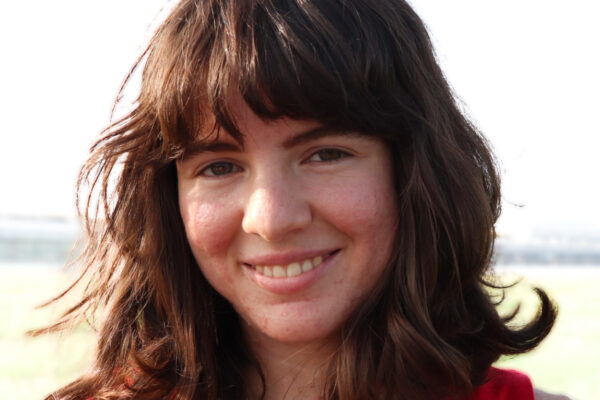
Lienke Roos
Lienke Roos is completing her Master’s in Spiritual Care, part of Theology and Religious Studies, currently in the final stages of her thesis, [Re]imagining a Possible Future. She also holds a Master’s degree in Visual Anthropology and a BA in Liberal Arts, where she took a few courses on international relations and migration.
The image/imaginary and the stories we tell are central to her work, a theme she explores both in her thesis and through her background in visual anthropology and filmmaking.
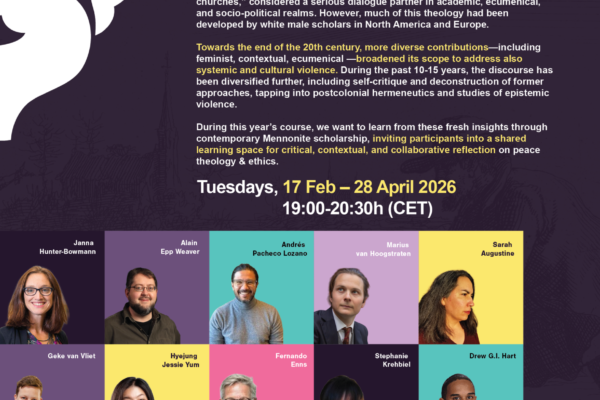
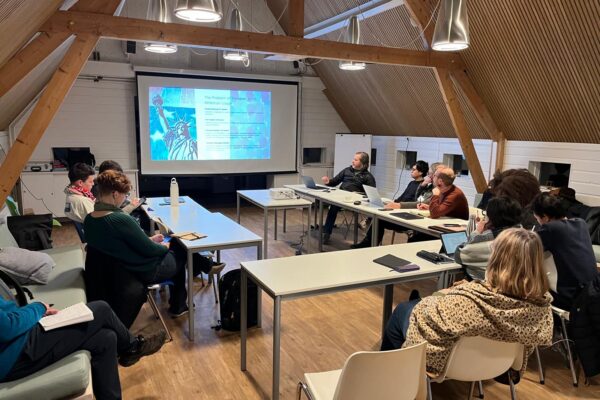
For her, taking part in the course with Fernando and Andrés, surrounded by so many different worldviews, is a true celebration: an opportunity to finally pursue long-held interests and to exchange and learn from one another.