PhD Candidate: Heinrich Wiens
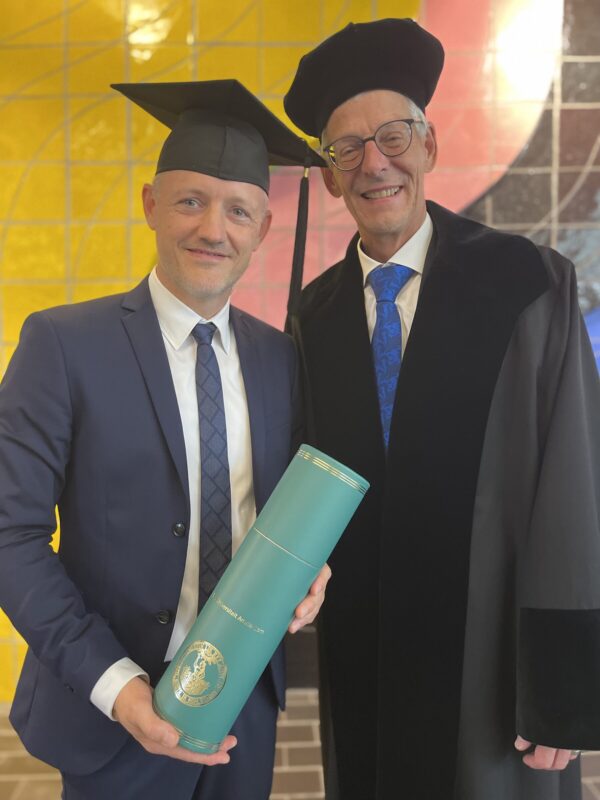
My name is Heinrich Wiens, and I am part of the Russian-German community with a Mennonite heritage. In my professional work, I am also involved with the Museum of Russian-German Cultural History, among other things, which led me to my research project…
The question of identity and self-understanding takes on existential significance where religious beliefs are not only subject to social discrimination, but are also banned by the state authorities and subject to criminal prosecution. It is precisely this experience that has shaped the community at the heart of my research: Russian-Germans with a Mennonite tradition.
According to Diether Götz Lichdi, this is the ‘largest and most important group’ of Mennonites in Germany (around 300,000 to 400,000 people) – yet the lived experience of their faith has scarcely been studied to date. Shaped by migration over generations (including emigration to the Russian Empire in the 18th century), they experienced Soviet repression in the 20th century – in the words of Prof. Katya Tolstaya, “extreme dehumanization” – which for them meant “institutional death” – affecting both material assets (such as the desacralization and repurposing of church buildings or the ban on printing the Bible), intangible spheres (the conviction and execution of clergy in Troika trials) – as well as exclusion from public life. This experience, in particular, compels a reorientation of their religious self-understanding.
This gave rise to the central question of my study: To what extent do historical and cultural experiences shape the self-understanding of a ‘church under dictatorship’?
I analysed autobiographical material from the collection of the Museum of Russian-German Cultural History in Detmold. It was only with the fall of the Iron Curtain and migration to Germany that a safe space for coming to terms with their own history became possible, giving rise to a distinct tradition of autobiographical writing among Mennonite-Russian-German.
‘Yesterday is not over’ – these texts do more than simply preserve the past: in the words of Maurice Halbwachs, these texts are both an ensemble of memories and a value-laden representation which – in the sense described by Aleida Assmann become building blocks of a cultural memory. Autobiographical writing itself thus becomes an act of self-empowerment: it breaks the silence, reclaims the interpretive authority, and interprets life stories as meaningful and guided by God.
The result of my work is the outline of a ‘post-Gulag piety’ – a form of religious practice and interpretation that emerged under conditions of extreme threat.
Faith played a dual role in this: as both the cause of persecution and the response to it. This finding thus contradicts the Soviet assumption that the Church disappears under repressive conditions. Rather, faith changes and becomes a lived piety – the actual driving force. Four characteristics are central.
Firstly, theologically: divine sovereignty. Survival is not regarded as a matter of chance, but as preservation by God – not ‘I have survived’, but ‘I have been preserved’.
Secondly, eschatologically: the focus on the hereafter. Those who lose everything in this life shift their hope to a ‘heavenly home’.
Thirdly, ecclesiologically: the congregation as a spiritual anchor. As churches were closed, faith shifted into private spaces; clandestine house churches formed a religious counter-culture and protected individuals from isolation.
Fourthly, ethically: internalised faith as a form of resistance. Where professing one’s faith became life-threatening, faith turned inwards and found expression in one’s way of life. The state can control behaviour and words, but not faith and conscience.
This gave rise to a practice of faith based on the following values: sanctification as the foundation, non-violence, integrity, a work ethic and diaconal service as expressions of discipleship – embedded in the hope of transcendent justice, which leaves earthly injustice to God.
The core theological contribution of the autobiographies lies in reflecting on enforced suffering coram Deo and translating it into a (diaconal) mission – the reality and ideal of a ‘church under dictatorship’.
The inscription at the Friedland Memorial, for many Russian-Germans the place of their first arrival in Germany, sums up the central message of the autobiographies well:
‘Peoples, renounce hatred, be reconciled, serve peace – build bridges between one another.’
Written by: Heinrich Wiens